Last updated November 2026. The rules are changing, so check locally before you design.
Short answer: Yes, in most cases you can build an accessory dwelling unit (ADU) in Coeur d’Alene, Post Falls or Hayden. Since July 1, 2026, Idaho law has barred cities with more than 10,000 residents from banning accessory dwelling units in single-family zones. These cities must update their codes by February 1, 2027, so confirm with the planning department which rules apply to your application today.
An ADU is a second, self-contained dwelling unit on the same lot as a single-family house, with its own living space, kitchen, bathroom and sleeping area. It can sit inside the primary home, be attached to it, or stand on its own as a detached structure. Homeowners in Kootenai County and across North Idaho build accessory dwelling units for aging parents, adult children, guests, a home office or long-term rental income. This guide answers the questions homeowners most often search for about what the rules allow.
At J. Barton Construction we design and build ADUs across Coeur d’Alene, Hayden and Post Falls, and we handle permits with local jurisdictions as part of each project. This guide explains what the 2026 state law changed, what each city’s published regulations say today, and what to check on your property before you pay for plans. If you already know you want to build, see our ADU design-build service in Coeur d’Alene.
This guide is general information, not legal advice. Zoning and building requirements apply property by property.
What did Idaho’s 2026 ADU law change for North Idaho homeowners?
Senate Bill 1354 was signed on March 31, 2026, and took effect July 1, 2026. It added Idaho Code 67-6541, which sets a floor for how Idaho cities with more than 10,000 residents treat accessory dwelling units on single-family lots. Cities can be less restrictive than the law, but not more. They have until February 1, 2027, to update their comprehensive plans and land use codes.
| Topic | What covered cities must allow (Idaho Code 67-6541) |
|---|---|
| Bans | No ban on accessory dwelling units in residential zones. An ADU counts as a residential use. |
| Maximum number | At least one accessory dwelling unit per single-family lot: either inside the house or detached (in the rear yard, or within the primary dwelling’s setbacks). |
| Maximum size limits | A city can’t cap an ADU below 1,000 square feet or 75% of the primary dwelling’s size. |
| Height | A city can’t set an ADU height limit lower than the existing primary home. |
| Setbacks, lot size, lot coverage | ADU rules can’t be stricter than those for single-family homes in the same zoning district. |
| Parking | No required off-street or guest parking, except where the primary home has no off-street parking, the street isn’t paved for on-street parking, or the lot is within a quarter mile of transit, an employment area or commercial services. |
| Owner occupancy | A city can’t impose owner occupancy: the property owner doesn’t have to live in the primary dwelling or the ADU. |
| Fees | Impact fees and utility connection fees can’t be higher than for other single-family homes. |
| Approval | An ADU that meets clear, objective standards must be approved administratively, as a matter of right, with no public hearing or other discretionary approval. |
What the law doesn’t change. Building and fire codes, floodplain regulations, water, sewer, drainage and road-access requirements, and protections for aquifers, steep slopes and critical habitat still apply. You still need a building permit. Historic districts and designated historic properties are excluded. So an ADU can be allowed in your zoning district and still be hard to build on a particular property.
One point to watch. The size rule reads “1,000 square feet or 75%” without saying which applies when the two differ, and the Coeur d’Alene Press headlined its October 14, 2026 report on the city’s review “City unpacks ‘ambiguous’ state housing regulation.” Homeowners should ask the city how it reads the size rule before a designer sets the floor plan.
HOAs. The same bill updated Idaho Code 55-3212. A homeowners association generally can’t add, amend or enforce a covenant that limits or prohibits accessory dwelling units unless the affected owner agrees in writing. An HOA can still adopt reasonable regulations on design, size, height, setbacks, open space, parking and bedrooms. Read your CC&Rs and ask an attorney if your HOA objects.
Where are ADUs allowed in Kootenai County? City-by-city comparison
The state law applies by population, so it covers Coeur d’Alene, Post Falls and Hayden, but not the smaller North Idaho cities around them or unincorporated county land. The table shows what each city’s own published code or ADU page said when we checked in November 2026. Where a local requirement is stricter than the state floor, expect it to change by February 1, 2027.
| City | Population (2020 census) | Covered by the state ADU law? | What the published regulations say today | What to ask |
|---|---|---|---|---|
| Coeur d’Alene | 54,628 | Yes | See the detailed section below. | Which size and parking requirements apply now, given the state law |
| Post Falls | 38,485 | Yes | City ADU page: one ADU per lot; maximum size of 50% of the main residence’s living area or 1,000 sq ft, whichever is smaller; detached ADUs go behind the main home (a corner lot may use the street-side yard); one extra paved off-street parking space; the permit needs a detailed site plan, mechanical plans and truss sheets, plus plan review. | Whether the 50% cap and the extra parking space still apply |
| Hayden | 15,570 | Yes | City code 11-2-5: one ADU per lot; up to 1,000 sq ft; set back at least 30 ft from the front and 10 ft from the side and rear property line; water and sewer connected through the primary home’s utilities; no new separate driveway approach. | Whether setbacks will match single-family standards |
| Rathdrum | 9,211 | Under 10,000 at the 2020 census | Local code applies. The city is growing, so coverage may depend on which population figure is used. | Whether the state law now applies |
| Dalton Gardens | 2,537 | No | Local reporting quotes the city code as prohibiting ADUs in the residential district (source). | Current code before buying or designing |
| Hayden Lake, Spirit Lake | 649 and 2,337 | No | Local code applies. | Current ADU requirements |
| Unincorporated Kootenai County | Not a city | No (the law covers cities) | The county code calls them “accessory living units.” For example, in the Agricultural zone one is allowed per parcel on parcels of 2 acres or more, under the standards in Section 8.4.301 of the county code. | Kootenai County Community Development, for your zone and parcel |
Populations are from the 2020 census table published by the Idaho Legislature. If your address says Coeur d’Alene, check whether the lot is inside city limits or in the county; the answer decides which regulations apply. Elsewhere, start with the Post Falls ADU page or the Hayden Building Department.
ADU rules, Coeur d’Alene: what the city code says today
A Coeur d’Alene ADU is regulated under city code 17.06.660 (adopted 2019, amended 2021). The city also publishes an ADU application packet marked 08-2026. Neither document mentions the 2026 state law yet, so some of these standards, especially size and parking, are likely to change by February 1, 2027.
| Standard | Coeur d’Alene code and packet |
|---|---|
| Number | One ADU, subordinate to an existing single-family dwelling. Total occupants of both units can’t exceed the city’s definition of a family. |
| Minimum size | None. |
| Maximum size | 800 sq ft of finished area (unfinished basements don’t count), and no more than 75% of the primary dwelling’s total square footage, excluding the garage. |
| Height | 18 ft for a one-story ADU in the rear yard; 24 ft for an ADU over a detached garage in the rear yard, with a second-story step-back. |
| Setbacks in the rear 25 ft of the lot | At least 5 ft from the side and rear lot lines; 3 ft from the rear property line if the lot has an alley. |
| Parking | One space for the ADU plus two for the main house, each 9 x 20 ft. |
| Pervious surface | At least 30% of the lot must stay pervious (grass, pavers, gravel, decking and similar). |
| Owner occupancy | Required only if one of the units is used as a short-term or vacation rental: a majority owner must then live in one of them. |
| Short-term rentals | Stays under 30 days must follow the city’s short-term rental requirements. |
| Ownership | The ADU can’t be subdivided or sold separately from the main house. |
| Recording | The owner records an agreement and notice to title with the county, including a statement that future buyers will be told about the ADU limits. |
How do you get an ADU permit in Coeur d’Alene?
The packet lists these steps and documents:
- Application form to the Planning Department, with a $150 review fee (per the 08-2026 packet).
- Site plan showing the ADU, setbacks and parking.
- Building plans: floor plans and elevations of all sides, plus second-story step-back elevations if there is a second story.
- Lot coverage and pervious surface plan with calculations.
- Signed agreement and recorded notice to title.
- Building permit, issued after planning review checks the plans for zoning compliance.
The Planning Department’s number in the packet is 208-769-2274.
Free ADU plans. The City of Coeur d’Alene’s ADU page lists free ADU plan sets sponsored by the Housing Solutions Partnership. The city says four plan sets were reviewed by local building and planning officials and are free to use in Kootenai County. A plan set still has to be fitted to your lot, utilities and permits.
For permit basics on other projects, see our remodel permit guide for Coeur d’Alene and Kootenai County. Outside Coeur d’Alene, see our Post Falls ADU builders and Hayden ADU builders pages.
Detached ADUs, attached ADUs, an existing garage or a detached garage: which requirements matter most?
We build three kinds of ADU. Each type runs into a different part of the regulations.
| ADU type | What it is | Requirements that usually decide it |
|---|---|---|
| Detached ADUs | A separate small home in the rear yard (a detached structure), sometimes called a backyard cottage | Rear-yard placement, setbacks, lot coverage, height, and how water, sewer and power reach the detached unit |
| Attached ADUs | Built onto the existing home with its own entrance | Setbacks and lot coverage of the combined building, plus the structural tie-in to the principal structure |
| Garage ADUs | An existing garage turned into living space, or a living unit built over a detached garage | Maximum size, height (for a second story), building-code upgrades to the existing structure, and utilities |
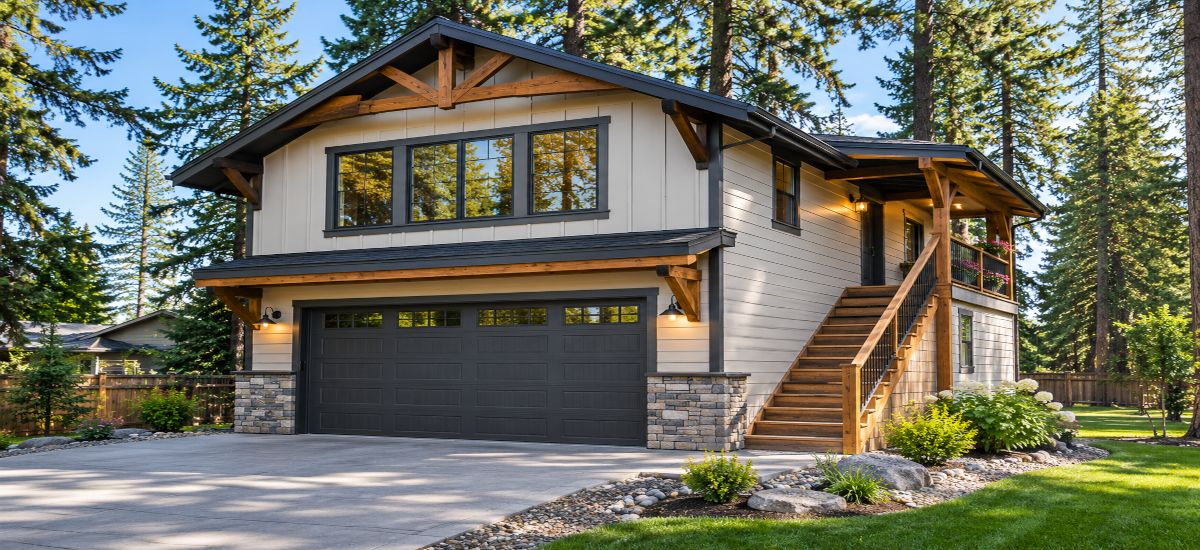
One example from our portfolio is a two-story garage with a finished ADU, built from the exterior to the bedrooms.
Not sure whether you need an ADU at all? Our home addition vs ADU guide compares adding living space to the main house with building a separate unit.
What should you check on your property before paying for plans?
A change in the law doesn’t make every lot buildable. These are the questions we look at first during a feasibility review of an ADU project:
- Jurisdiction. Is the lot inside city limits, in a smaller city, or in unincorporated Kootenai County? Local jurisdictions don’t follow the same regulations, so this decides which county code or city code applies.
- Zoning and HOA. Is it a single-family lot? Does your HOA have standards on design, size or parking?
- Sewer or septic capacity. Can the existing system, or the city connection, serve a second dwelling unit?
- Utility access. How will water, sewer and power reach a detached unit? In Hayden, for example, the published code requires water and sewer to connect through the primary home’s utilities.
- Setbacks, lot coverage and pervious surface. How much buildable area is left in the rear yard?
- Access and parking. Can construction equipment reach the site? Does the lot fall into one of the state law’s parking exceptions?
- Site conditions. Slope, drainage, floodplain or other site limits that the state law leaves in place.
For custom homes, our site feasibility guide for Kootenai County goes deeper on slope, wells, septic and access, and much of it applies to detached ADUs too.

How much does an ADU cost and how long does it take?
Regulations are only half the decision; budget and timeline are the other half. These are the planning ranges published on our ADU service page.
| Item | Planning range (J. Barton Construction) |
|---|---|
| Construction cost | About $200 to $350 per square foot |
| Typical total | Roughly $120,000 to $300,000+, depending on size, site and finishes |
| Design and permitting | About 2 to 4 months |
| Construction | About 4 to 8 months |
Actual time depends on project complexity, the jurisdiction’s requirements, permits and site conditions. If rental income is part of your plan, test it against these ranges before you commit.
How does J. Barton Construction help with an ADU project?
We’re a design-build general contractor in Coeur d’Alene, Idaho, building in Coeur d’Alene, Hayden, Post Falls and nearby Kootenai County in North Idaho. Josh Barton founded the company in 2018, and it has been based in Coeur d’Alene since 2019. We are licensed, bonded and insured in Idaho. For an ADU project, one team handles the whole job:
- Feasibility. We review the lot, the jurisdiction’s requirements, utilities and access.
- Design and pricing. Under a Professional Services Agreement, we set scope, selections and budget before construction. You then get a fixed-price construction proposal.
- Permitting. We handle the permits and coordinate with the city or county until approval.
- Construction. A dedicated project manager is your main contact. Any change you ask for goes through a written change order that shows its cost and schedule impact first.
- Completion. A final walkthrough, then a three-year labor warranty on our workmanship.
For more on how fixed-price planning works, read our design-build planning guide.
Frequently asked questions about a Coeur d’Alene ADU
These are common questions homeowners search for about accessory dwelling units in Kootenai County.
Can I build an ADU in Coeur d’Alene, Idaho?
In most single-family zones, yes. Since July 1, 2026, state law has barred Coeur d’Alene from banning accessory dwelling units in residential zones and has required it to allow at least one ADU per single-family lot. Historic districts and designated historic properties are excluded, and building, utility and site requirements still apply.
How big can an ADU be in Idaho?
In covered cities, state law says a city can’t cap an ADU below 1,000 square feet or 75% of the primary dwelling’s size. Current local limits differ: 800 sq ft and 75% in Coeur d’Alene’s code, 50% of living area or 1,000 sq ft in Post Falls, and 1,000 sq ft in Hayden. Confirm which maximum size the city will apply to your plans.
Is there a minimum size for an ADU?
Coeur d’Alene’s 2026 ADU packet lists no minimum size. The unit still needs its own kitchen, bathroom and sleeping area and must meet the building code.
How close to the property line can I build an ADU?
It depends on the city and zone. In the rear 25 ft of a Coeur d’Alene lot, the city code requires at least 5 ft from the side and rear lot lines, or 3 ft from the rear line where there’s an alley. Hayden’s code requires 10 ft from the side and rear property line and 30 ft from the front. Under Idaho Code 67-6541, covered cities can’t make ADU setbacks stricter than single-family setbacks in the same zone.
Do I have to live on the property?
Under Idaho Code 67-6541, covered cities can’t require owner occupancy of the primary dwelling or the ADU, which matters if you plan long-term rental income from either unit. Coeur d’Alene’s code requires a majority owner to live on site only when one of the units is a short-term rental. Ask the planning department how it applies that rule now.
Do I need an extra parking space?
Covered cities generally can’t require off-street or guest parking for an ADU. Exceptions apply if the primary home has no off-street parking, the street isn’t paved for on-street parking, or the lot is within a quarter mile of transit, an employment area or commercial services. Coeur d’Alene’s and Post Falls’ published requirements still list one extra space.
Can I put a tiny house on my property in Idaho?
Not as an ADU if it’s on wheels. Idaho Code 67-6541 excludes motorhomes, campers, recreational vehicles and tiny homes on wheels from its ADU definition. A small home built on a foundation that meets the building code can qualify as a detached ADU.
Can my HOA stop me from building an ADU?
Under Idaho Code 55-3212, an HOA generally can’t add, amend or enforce a covenant that limits or prohibits ADUs unless the affected owner agrees in writing. It can still set reasonable standards on design, size, height, setbacks, open space, parking and bedrooms. Ask an attorney about your specific covenants.
Can I use my ADU as a vacation rental?
Long-term rental income is a common reason to build. Short term rentals depend on local regulations: in Coeur d’Alene, an ADU used for stays under 30 days must follow the city’s short-term rental requirements, and a majority owner must live in one of the units. Check with your city before planning around nightly rental income.
Can I sell the ADU separately?
Not in Coeur d’Alene. The city code says an ADU can’t be subdivided or held in separate ownership from the main house.
Does the law apply in Rathdrum, Dalton Gardens or rural Kootenai County?
The law covers cities with more than 10,000 residents. Dalton Gardens (2,537 at the 2020 census) and unincorporated county land aren’t covered. Rathdrum had 9,211 residents at the 2020 census, so ask the city whether it now applies. Local or county regulations apply where the statute doesn’t.
How much does it cost to build an ADU in Idaho?
Our planning range in North Idaho is about $200 to $350 per square foot, or roughly $120,000 to $300,000+ in total, depending on size, site and finishes. Design and permitting usually take about 2 to 4 months, then about 4 to 8 months of construction.
Talk through your lot
The fastest way to know what’s possible is a feasibility review of your actual property. Tell us your address and what you’d like to build, and we’ll look at the rules, utilities and access for accessory dwelling units on your lot before you spend money on plans. Request a free feasibility consultation, or read more about our ADU builders in Coeur d’Alene.