Last updated November 2026. Planning ranges from J. Barton Construction for Coeur d’Alene, Hayden, Post Falls and nearby Kootenai County.
Short answer: ADU cost in Idaho’s Coeur d’Alene area typically runs about $200 to $350 per square foot, or roughly $120,000 to $300,000+ in total, depending on size, site and finishes. Plan on about 2 to 4 months for design and permitting, then about 4 to 8 months of ADU construction in Idaho’s Panhandle. After feasibility and design, we give you a fixed-price proposal, so the full cost is clear before construction starts.
Those are the ranges we publish for the accessory dwelling units we design and build in North Idaho. This guide explains what moves an ADU cost toward the low or high end of the range, how homeowners typically pay for an ADU, and how long each phase of ADU construction takes. For what the cities allow, see our companion guide to ADU rules in Coeur d’Alene, Post Falls and Hayden. If you’re ready to talk about your lot, see our ADU design-build service in Coeur d’Alene.
| Planning range (J. Barton Construction) | |
|---|---|
| Cost per square foot | About $200 to $350 per sq ft |
| Example: 600 sq ft unit | About $120,000 to $210,000 |
| Typical total project | Roughly $120,000 to $300,000+ |
| Design and permitting | About 2 to 4 months |
| ADU construction | About 4 to 8 months |
A quick way to use the range. Multiply the square footage you have in mind by the per-square-foot range. For example, a 600 sq ft ADU at $200 to $350 per square foot works out to $120,000 to $210,000 before anything unusual about the site. That’s arithmetic on the published range, not an estimate for your specific project. Your lot, utilities and finish level decide the real number, and ADU costs depend heavily on whether you’re converting an existing structure or building a new one.
Garage conversion, attached ADU or detached ADU: what is the cost to build each ADU type?
We build three kinds of ADU in Idaho. Each ADU type needs a different amount of new structure, foundation and utility work, so each lands differently in the range.
| ADU type | What it is | How it tends to compare on cost |
|---|---|---|
| Garage conversion | Turns an existing garage into a livable unit, usually within the garage’s existing footprint | Often the fastest and most cost-efficient path to adding an ADU |
| Attached ADU | Built as an addition to the main house, sharing a wall with it | A cost-effective option that keeps the unit close to the primary home |
| Detached ADU | A standalone structure in the backyard, built separately from the main house | Needs its own foundation and utility connections, so costs differ from conversions or attached units; it offers the most privacy |
What type of ADU is the cheapest? On our ADU page we describe converting an existing garage as often the fastest and most cost-efficient path, because part of the structure is already there. Garage conversion costs still depend on what the existing garage needs to become living space, including insulation, plumbing, electrical work and building-code upgrades. Because an ADU needs its own kitchen and bathroom, a garage conversion usually needs new plumbing runs.
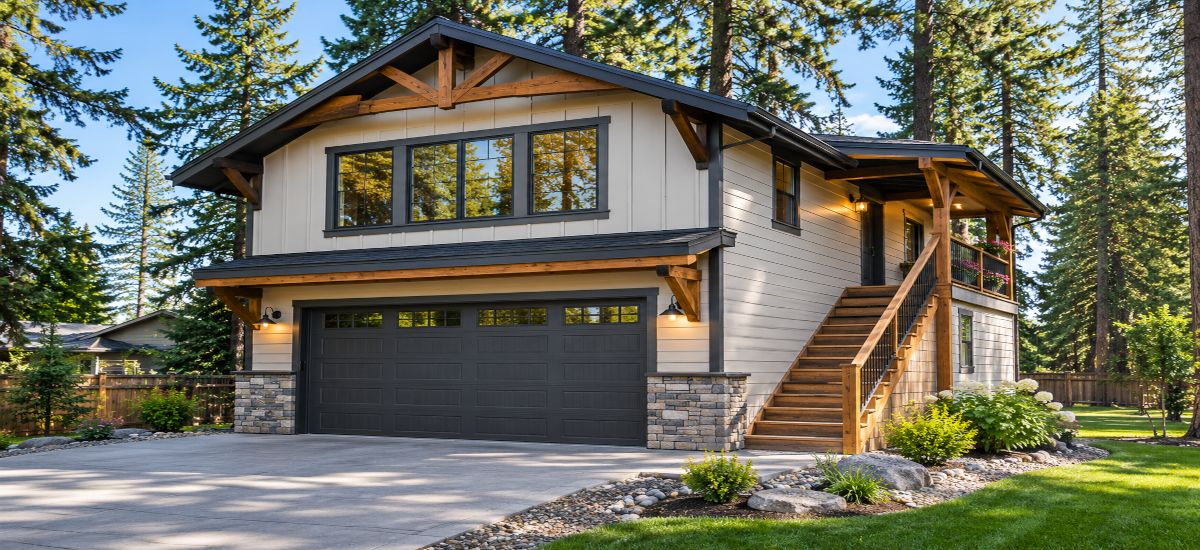
Detached ADU or a unit over a detached garage? A single story detached ADU and a second story unit built over a garage are built differently, so their foundation cost, framing and access needs differ. One example is our garage ADU project, a two-story garage with a finished ADU.

What drives ADU cost in Coeur d’Alene, Hayden and Post Falls?
Two ADUs of the same square footage can land at opposite ends of the range. These are the factors that move the price:
| Cost driver | Why it matters |
|---|---|
| Size | The per-square-foot range applies to the whole unit, so an 800 sq ft unit costs more than a 500 sq ft unit with the same finishes. |
| ADU type | A detached ADU needs a new foundation and its own utility connections; a garage conversion or attached ADU may reuse existing structure. |
| Foundation and site work | Slope, drainage, excavation and access for equipment all add work before the walls go up. |
| Utility connections | Water, sewer or septic capacity, plumbing and electrical service have to reach the unit, and utility work can be one of the bigger cost swings. In Hayden, for example, the city code requires ADU water and sewer to connect through the main home’s utilities rather than separate utilities. |
| Structure | A single story cottage, an attached unit and a second story unit over a garage are built differently. |
| Finish level | The unit’s own kitchen and bathroom, cabinets, flooring, fixtures and appliances can move the total as much as the structure does. |
| Permits and fees | Building permits, plan review and any impact fees or utility connection fees. Zoning rules and permit fees vary by city. |
ADU permit fees, permit costs and impact fees
Two fee facts are worth knowing before you set an ADU budget:
- State law limits ADU fees in covered cities. Under Idaho Code 67-6541, cities with more than 10,000 residents, including Coeur d’Alene, Post Falls and Hayden, can’t charge higher impact fees or utility connection fees for an ADU than for other single-family homes.
- Coeur d’Alene charges a $150 ADU review fee, according to the city’s ADU application packet (marked 08-2026). Building permit fees are separate. Ask the city’s planning department for the current fee schedule before you set a budget; permit costs depend on the specific project. Coeur d’Alene’s code also has its own ADU size and parking standards, covered in our rules guide.
What we check before pricing
Before we give a fixed-price proposal, we assess zoning, utilities and site conditions to confirm your property can support an ADU. That includes sewer or septic capacity, utility access, setbacks and lot coverage, which affect both what you can build and what it costs. Our site feasibility guide for Kootenai County covers slope, septic and access in more depth.
How do homeowners pay for an ADU?
The common ways to pay for an ADU in Idaho, including Coeur d’Alene and Post Falls, are cash, the equity in your primary home, or a loan. We’re a builder, not a lender, so the right option is a conversation with your bank, credit union or mortgage lender. The table explains the common options in plain terms, using the Consumer Financial Protection Bureau’s descriptions.
| Option | How it works | What to know |
|---|---|---|
| Cash or savings | You pay the project with your own money | No interest or loan approval, but it ties up savings |
| Home equity loan | You borrow against your home’s equity and usually receive the money at once, then repay it in monthly installments | Your home is the collateral |
| Home equity line of credit (HELOC) | A line of credit against your home’s equity: you borrow as needed during a draw period, then repay during a repayment period | Rates are typically variable, and the CFPB warns that if you can’t repay, you could lose your home |
| Cash-out refinance | You replace your current mortgage with a larger one and keep the difference as cash | You usually pay closing costs, and the new rate may be higher than your current one |
| Construction loan or renovation loan | Some lenders offer loans designed to fund a building project | Terms and eligibility vary by lender, so ask whether they lend on ADUs |
Home equity loan, HELOC or construction loan?
A home equity loan gives you the money at once; a HELOC lets you draw as the ADU construction budget is spent; a construction loan is set up for building projects. Which fits depends on your equity, your rate and how your lender handles a construction budget, so ask two or three lenders the same questions.
Sources: CFPB, types of home equity loans and What You Should Know About Home Equity Lines of Credit.
How our process helps with financing. Lenders want to know what the project will cost. Because we set scope, selections and budget under a Professional Services Agreement before construction, and then give you a fixed-price construction proposal, you have a defined number to take to your lender instead of a rough estimate.
This section is general information, not financial advice. Compare options with a qualified lender or financial advisor; a HUD-approved housing counselor can also help.
How long does it take to build an ADU in Idaho?
Plan on about 2 to 4 months for the design phase and permitting process, then about 4 to 8 months of construction. The overall time depends on project complexity, the local jurisdiction’s requirements and site conditions. Utility work, plan review, inspections, material availability and the ADU type also affect the schedule.
| Phase | What happens | Typical time |
|---|---|---|
| 1. Feasibility and site evaluation | We assess zoning, utilities and site conditions to confirm your property can support an ADU | About 2 to 4 months for phases 1 to 3 combined |
| 2. Design and fixed pricing | We develop plans and give you a fixed-price proposal | Included above |
| 3. Permitting and approvals | We handle the permitting process and coordinate with the local jurisdiction | Included above |
| 4. ADU construction | Our team manages the full build, with consistent communication and quality control | About 4 to 8 months |
| 5. Completion | Final walkthrough, inspections and delivery of a completed, move-in-ready ADU | End of construction |
In Coeur d’Alene, the city’s ADU packet lists what the permit application needs: an application form, a site plan, floor plans and elevations, a lot coverage and pervious surface plan, and a recorded notice to title. A building permit is issued after review. Our ADU rules guide walks through the steps.

What can an ADU be used for? Rental income, family and more
How you plan to use the unit affects its layout and budget, so it’s worth deciding before you build an ADU. These are the uses we design for:
- Rental income and long-term cash flow
- A guest house or private visitor accommodations
- Multi-generational living, including aging parents or adult children, and aging in place
- Short-term rental, where the city allows it. In Coeur d’Alene, stays under 30 days must follow the city’s short-term rental rules, and a majority owner must live in one of the units.
- A home office or flexible living space
Is an ADU worth the cost? It depends on how you’ll use it, your lot and your budget. We can’t predict rent, rental income potential or resale value for your property, and we don’t give estimates of them. If rental income is part of your plan, compare local rents with the cost ranges above before you commit.
How J. Barton Construction builds your ADU
We’re a design-build general contractor based in Coeur d’Alene, Idaho, founded by Josh Barton in 2018 and based in Coeur d’Alene since 2019. We’re licensed, bonded and insured in Idaho. As a general contractor in Idaho we also build custom homes (custom home building in Coeur d’Alene) and handle kitchen, bathroom and whole-home remodels. One team handles the whole ADU:
- Pre-construction. Under a Professional Services Agreement, we set scope, selections and budget before construction.
- Fixed-price proposal. You see the full construction cost upfront.
- Changes. Anything you change during the build goes through a written change order that shows its cost and schedule impact first.
- One point of contact. A dedicated project manager keeps you updated.
- Warranty. After the final walkthrough, a three-year labor warranty covers our workmanship.
Read more about how fixed-price, design-build planning works.
ADU cost Idaho FAQ: common questions from homeowners
How much does an ADU cost in Idaho?
For the ADUs we build in Idaho’s Coeur d’Alene, Hayden, Post Falls and nearby Kootenai County, plan on about $200 to $350 per sq ft, or roughly $120,000 to $300,000+ in total for accessory dwelling units, depending on size, site and finish level.
Is a garage conversion cheaper than a detached ADU?
Converting an existing garage is often the fastest and most cost-efficient way to add an ADU, because some of the structure already exists. A detached ADU needs its own foundation and utility connections, so it usually involves more site work and a larger budget for the foundation and utilities.
How big can an ADU be in Idaho?
In cities with more than 10,000 residents, Idaho Code 67-6541 says a city can’t cap an ADU below 1,000 square feet or 75% of the main home’s size. Local limits are still being updated; see our ADU rules guide for each city.
How long does it take to build an ADU in North Idaho?
About 2 to 4 months for design and permitting, then about 4 to 8 months of construction. Complexity, the city’s requirements and site conditions change that.
How do people finance an ADU in Coeur d’Alene or Post Falls?
Common options are cash, a home equity loan, a home equity line of credit (HELOC), a cash-out refinance, or a construction loan or renovation loan. Home equity options use your home as collateral, so compare them carefully with a lender.
Does J. Barton Construction offer ADU financing?
We’re a builder, not a lender, so we don’t provide loans. What we do provide is a fixed-price construction proposal, which gives you a defined project cost to take to your lender.
Are ADU impact fees higher than for a house?
Not in covered cities. Idaho Code 67-6541 bars cities with more than 10,000 residents from charging higher impact fees or utility connection fees for an ADU than for other single-family homes.
Can I get a fixed price for my ADU?
Yes. After feasibility and design, we give you a fixed-price proposal so the full cost is clear upfront. Changes you ask for later go through a written change order that shows the cost before work proceeds.
Get a real number for your lot
The ranges above are a starting point, not an estimate. Whichever contractor you talk to, ask for a written, itemized estimate or a fixed-price proposal before you commit. Your lot, utilities and choices decide the real ADU cost, and we price it after a feasibility review of your site. Tell us your address and what you’d like to build, and we’ll start with a feasibility review. Request a free feasibility consultation, or read more about our ADU builders in Coeur d’Alene.